
Constitutional Reforms on Civic Democratic Principles (Circle 99)
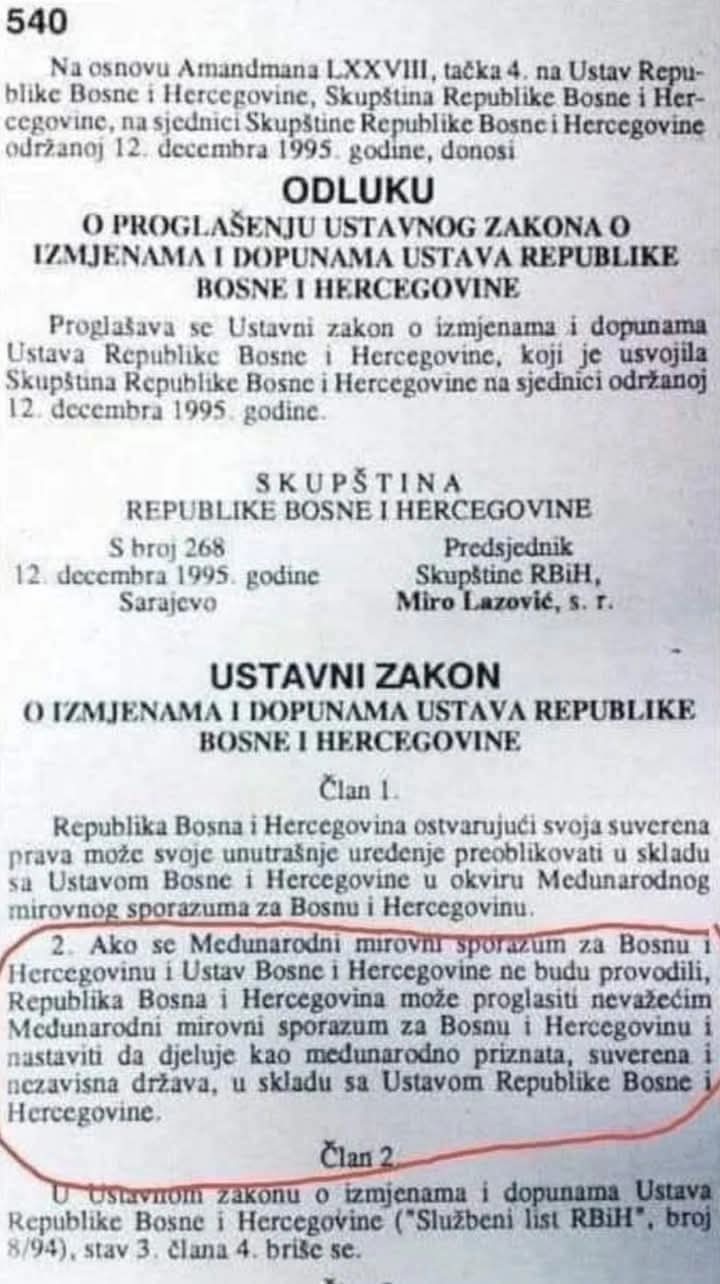
Constitutional Reforms on Civic Democratic Principles
Beginning from the principles and goals of the United Nation Charter;
Dedicated to liberal democracy, peace, justice, solidarity and mutual understanding;
Believing that Bosnia and Herzegovina should be a secular state with a republican form of government, based on parliamentary democracy, the rule of law and free and democratic elections;
Committed to the sovereignty, territorial integrity and political independence of Bosnia and Herzegovina in line with international law;
Guided by the principles, values and standards of the Human Rights Universal Declaration, the International Covenant on Civil and Political Rights, the International Covenant on Economic, Social and Cultural Rights, the European Convention on Human Rights and Fundamental Freedoms, the Declaration on the Rights of Persons Belonging to Ethnic, Religious and Linguistic Minorities, as well as other instruments aimed at protecting individual human rights as well as by the act of admission of the Republic of Bosnia and Herzegovina to the United Nations on 22 May 1992;
Considering that the equality, freedoms and rights of the citizens of Bosnia and Herzegovina as the holders of state sovereignty, should be guaranteed, ensured and implemented in all aspects of society;
Considering in particular that Bosnia and Herzegovina is a state of all its citizens, who together with their ethnic, religious and cultural diversity being fully respected, form the Bosnia and Herzegovina/Bosnian nation, which was confirmed by our country’s admission to the United Nations;
Taking into account all the previous opinions of the Venice Commission on the political, social, electoral and judicial system in Bosnia and Herzegovina;
Recognizing how the current socio-political system is undermining the culture of togetherness, distancing ethnic groups, and creating conflicts among political elites to the detriment of individual human rights;
Noting the apparent stagnation of Bosnia and Herzegovina on its path towards full membership of the European Union and NATO, by deliberately hindering reform processes, including fulfilling the 14 key priorities set out in the Opinion of the European Commission, as well as blocking the defining of each Programme of reforms for Bosnia and Herzegovina;
Emphasizing the need for the political, social and economic system to be harmonized with the norms, values and standards of the European Acquis Communautaire that the European Union is founded on;
Aware that the current Constitution of Bosnia and Herzegovina has been found to contain systemic discrimination of citizens based on their ethnicity and place of residence, which has been specifically established by the judgments of the European Court of Human Rights in Strasbourg in the cases: Sejdić-Finci, Zornić, Pilav, Šlaku, Pudarić and Kovačević;
Bearing in mind the centuries-old ethno-territorial indivisibility of the state territory of Bosnia and Herzegovina, with its citizens living in diversity and equality, the Declaration on the Rights of Citizens from the Second Session of ZAVNOBIH (convened on 1st July 1944 in Sanski Most), the Constitution of the Republic of Bosnia and Herzegovina, the results of the Citizens’ Referendum (1992) organized across the entire territory of Bosnia and Herzegovina and under the international supervision and initiative;
Convinced that civically constituted authorities and fair procedures best create inclusive relations within a pluralistic society in which there are equal opportunities for all citizens;
Recognizing all the verdicts of the International Criminal Tribunal in The Hague (ICTY) which have established that the crimes of genocide, war crimes, crimes against humanity and joint criminal enterprises were committed with the aim of creating mono-ethnic areas of the territory in Bosnia and Herzegovina through ethnic cleansing, and emphasizing that the current Constitution was imposed in these circumstances;
Determined that the electoral legislation of Bosnia and Herzegovina must not deviate from European electoral principles and standards, nor introduce further discrimination against citizens in their active and passive electoral rights, nor create inequality in votes of citizens based on their ethnicity and place of residence;
Emphasizing the need for the economic system of Bosnia and Herzegovina to operate in a single market to the benefit of all its citizens;
Seeking to create the prerequisites for the reform of the current constitutional arrangement of this country and its harmonization with the requirements of the European Acquis Communautaire as well as the fundamental principles of the rule of law and liberal democracy, the Association of Independent Intellectuals Krug 99 (Circle99) proposes the following:
PRINCIPLES
of constitutional reform in Bosnia and Herzegovina
1. Bosnia and Herzegovina is a sovereign, unitary, indivisible, democratic, legal, secular state with its territorial integrity resulting from its thousand-years old existence and its international recognition.
2. The name of the state of Bosnia and Herzegovina shall be – the Republic of Bosnia and Herzegovina.
3. The capital of the Republic of Bosnia and Herzegovina shall be Sarajevo. The Republic of Bosnia and Herzegovina shall have an anthem and a flag which represent the identity, history, values and sovereignty of the state.
4. The bearer of sovereignty shall be a citizen – a citizen of the Republic of Bosnia and Herzegovina. The sovereignty of citizens shall be inalienable, non-transferable and indivisible.
5. The Republic of Bosnia and Herzegovina shall be a single state with a unitary form of state organization, which shall have a central authority and a level of local self-governance units organised in accordance with the European Charter on Local Self-Government. The area of local self-governance shall be organised in municipalities and cities. Linking municipalities and cities regionally shall be possible solely on the basis of natural characteristics and economic interests, which shall be regulated by a special law.
6. The executive powers will rest with the President of the Republic of Bosnia and Herzegovina and the Government, each operating within its own remits. The President of the Republic of Bosnia and Herzegovina is to be elected in direct elections within one constituency, respecting the principle of ethnic diversity.
7. The Republic of Bosnia and Herzegovina shall have a Parliament, as a legislative body of its government, consisting of the number of representatives proportionate to the number of its citizens, and they shall be elected in direct elections in electoral units determined by the Electoral Law. The responsibility of the Parliament of the Republic of Bosnia and Herzegovina shall be the adoption of all regulations: the Constitution, laws and other acts, which regulate various aspects of social life in the Republic of Bosnia and Herzegovina. In addition to the Parliament of the Republic of Bosnia and Herzegovina, there shall be a Council for the Protection of Ethnic Interests, as a special body without legislative powers, whose exclusive jurisdiction shall be to consider and evaluate only those regulations that fall within the scope of the three (3) identity elements: language, culture and religion. The Council for the Protection of Ethnic Interests shall be appointed by the Parliament of the Republic of Bosnia and Herzegovina from among the elected representatives, in the manner determined by the Rules of the Parliamentary procedures.
8. The Republic of Bosnia and Herzegovina shall have a Government consisting of the Prime Minister and the following ministries: Ministry of Foreign Affairs, Ministry of Finance and Treasury, Ministry of Industry and Energy, Ministry of Agriculture and Forestry, Ministry of Communications and Transport, Ministry of Health, Ministry of Education and Science, Ministry of Culture and Sports, Ministry of Trade, Ministry of Diaspora, Ministry of Justice, Ministry of Internal Affairs, Ministry of Defense, Ministry of Labor and Social Policy, Ministry of Hospitality, Tourism and Environment. The Government of the Republic of Bosnia and Herzegovina shall be appointed by the Parliament of the Republic of Bosnia and Herzegovina, upon the proposal of the mandate holder. The mandate holder shall be appointed by the President of the Republic of Bosnia and Herzegovina.
9. The Constitution shall establish judicial power, which shall be exercised by courts of first instance, specialized courts and the Supreme Court, as well as the prosecution and defense offices and the High Judicial and Prosecutorial Council, which shall be regulated by law. The Constitutional Court shall review the compliance of all laws and legal acts with the Constitution, taking into account the European Convention on the Protection of Human Rights and Fundamental Freedoms, together with all Protocols thereto.
10. The Republic of Bosnia and Herzegovina shall have its own Central Bank, the forming, composition, scope of operations and functioning of which shall be regulated by a special law.
11. The Republic of Bosnia and Herzegovina shall hold the title to the state property ownership. Common property such as the sea, lakes, rivers, coasts, forests, air, water, frequencies and public goods such as highways, roads, squares, parks, may not be owned by any physical individual or legal entity, but the state shall have the right to dispose of and manage such a property, which it may transfer to lower levels of government. All aspects of state property, the right to its ownership, disposal and management shall be regulated by a special law.
12. The entire content of the Constitution must be in line with the European Convention of Human Rights and Fundamental Freedoms, together with all Protocols, recommendations of the Venice Commission and the Copenhagen and Madrid criteria regulating accession to the European Union, and shall be in all respects in line with the European acquis.
13. The adopted constitution shall contain provisions on a transitional period, which shall be limited in time and shall represent a period during which the necessary transition and harmonization of all applicable regulations and the transformation of existing state institutions and agencies shall be carried out in accordance with the new Constitution of the Republic of Bosnia and Herzegovina.
14. Amendments to the Constitution thus adopted shall be made by a 2/3 majority in the Parliament of the Republic of Bosnia and Herzegovina. Amendments to the Constitution of the Republic of Bosnia and Herzegovina in this way may not contain any element that diminishes or limits human rights established by this Constitution.
About The Author